
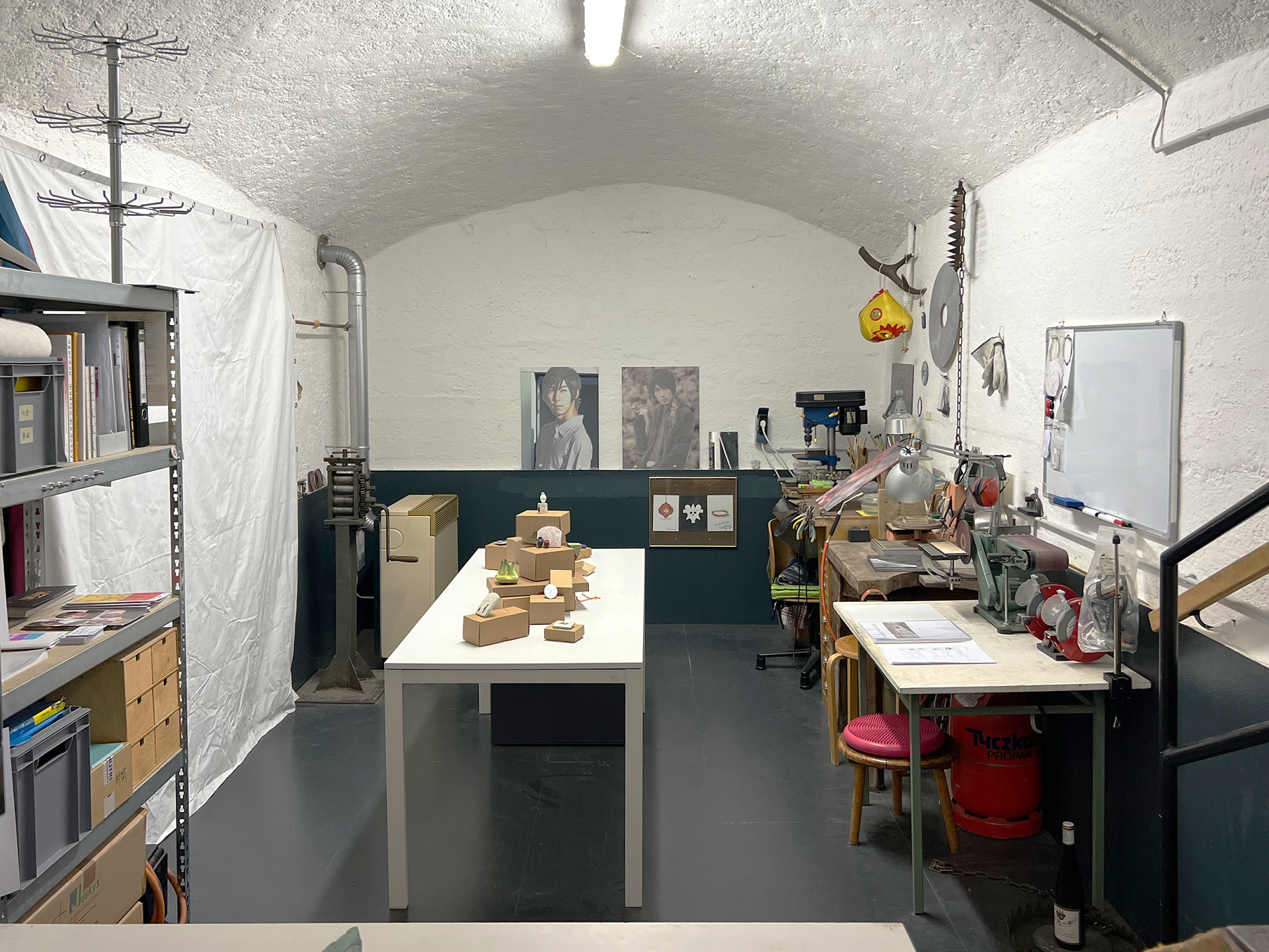
My practice is grounded in the theme of “the intersection of repetition and change,” which has emerged from the point where traditional knowledge and contemporary conditions intersect: my background in a rice-farming family, my training in traditional craft, my life between Japan and Germany, my position as an immigrant affected by policy shifts, and my long-standing engagement with volleyball since the age of thirteen. For me, repetition is not merely cyclical recurrence, but time accumulated through the body. Change refers to the continual transformation of society, technology, institutions, and bodily perception itself.
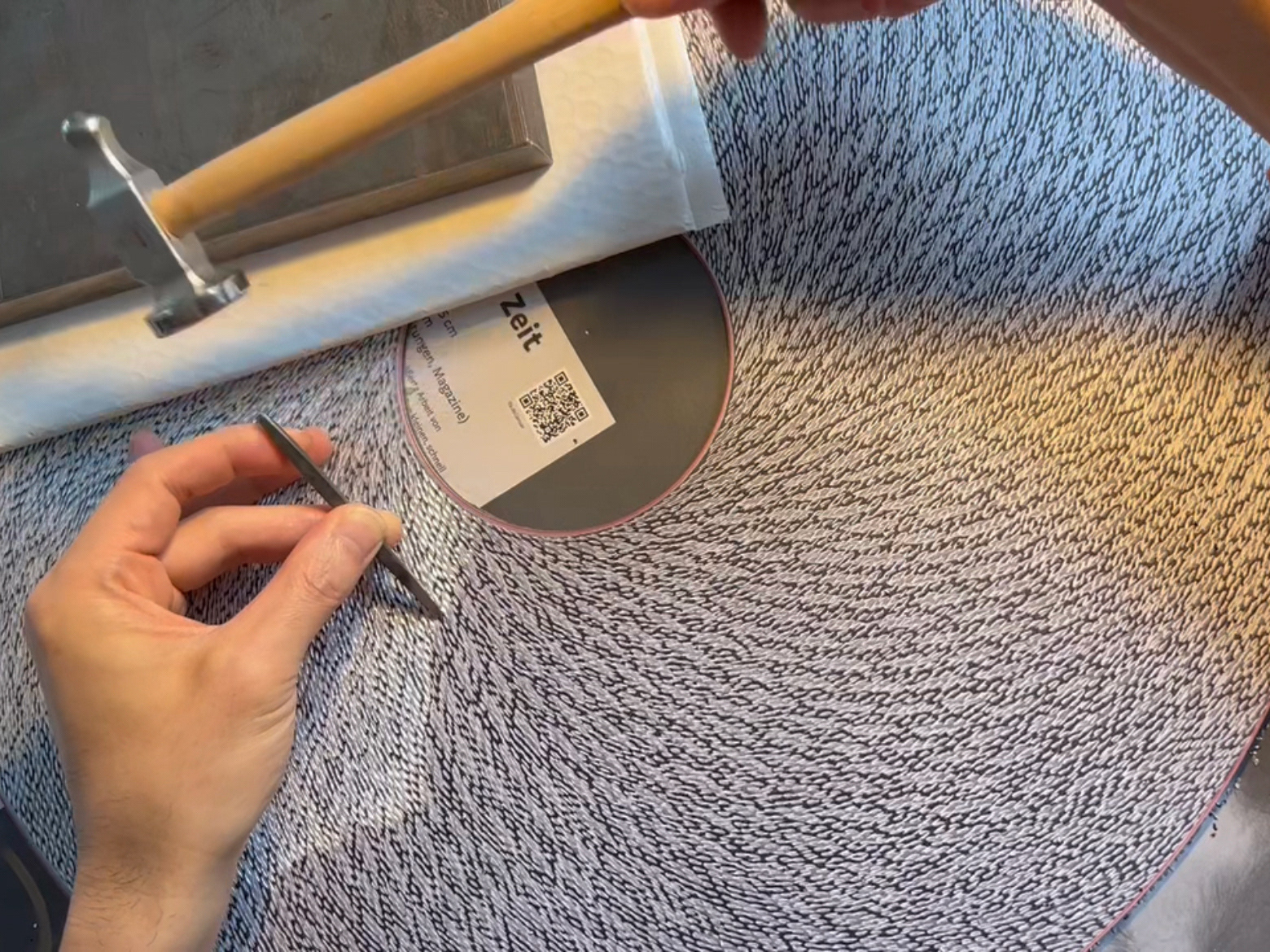
In Metal Painting and Layer / Re:, I have visualized material transformation and the accumulation of time through the movement between handcraft and digital processes. In AI Portrait and Is this Jewelry?, I have explored the instability of self-image and bodily perception within data-driven society and post-human conditions. In Memory of the Hand and Family Necklace, I continue to investigate how memories inherited across generations and communities can be fixed within material form.
For me, the techniques of craft and adornment are not formats for belonging to a specific genre, but devices for rethinking the relationships between body and society, individual and institution, memory and information. In particular, the act and mode of “wearing” have contained important visual information within various forms of artistic expression, including painted figures, moving images, comics, and fashion, as symbols of historical periods and social values. By incorporating the function or concept of wearing into my work, I understand it not as a mere visual object, but as an expression that connects the bodies and experiences of the artist, the wearer, and the viewer, generating multilayered relationships charged with a sense of involvement.
In recent years, I have named these practices grounded in adornment Interfigura: a form of inquiry that emerges from the “in-between” space of body and society. It is an attempt to reconsider wearability not simply as a function, but as a concept for reweaving relationships between the body, institutions, memory, and others, and to construct an original artistic language that offers new interpretations of constantly changing bodily perception and identity.
April 2026 Takayoshi Terajima
Summary of the Theory of Interfigura
Interfigura is a perspective that understands adornment not merely as decoration, craft, or a genre of jewelry, but as an artistic form that generates relationships between the body and society. Through its proximity to the body—by touching it, overlapping with it, or prompting the imagination of wearing—adornment connects the individual body to institutions, memory, community, value, technology, and the gaze of others. In this theory, Interfigura refers to the relational form that emerges between the body and society.
What is central to this perspective is a reconsideration of “wearability.” Wearability is not understood only as the practical function of being physically worn, but as an operation that generates a relationship with the body within the viewer’s imagination. When encountering an adornment-based work, viewers do not simply look at it. They begin to imagine: Who would wear it? What would happen if it were connected to my own body? Which bodies are made visible, and which bodies remain invisible? Through this “imagined wearability,” the viewer becomes involved with the work not merely as an observer, but as a potential wearer.
Interfigura is not a diagram or symbol intended to explain social issues. Rather, it is a method for drawing contemporary conditions—such as the classification of bodies by AI, immigration systems, inherited memory, gender, consumer society, and waste—toward the viewer’s own bodily perception. The work does not appear as a social issue located somewhere far away, but as a question that may concern one’s own body.
In this sense, the small scale, functionality, decorativeness, and marketability of adornment are not weaknesses within the context of contemporary art. On the contrary, they can become conditions that bring the work closer to the scale of the body and translate abstract institutions and social conditions into personal experience. Interfigura is not a term for forcibly positioning adornment within contemporary art, but a practical perspective for reconstructing the relationships between body, institution, technology, memory, and value.
私は、米農家としての出自、伝統工芸の修得、日独を往来する生活、政策転換に影響される移民としての立場、そして13歳から続けているバレーボールといった、伝統的な知と現代的状況が交差する地点から見えてきた「反復と変化の交錯」を主題として制作を行っています。反復とは単なる循環ではなく、身体を通じて蓄積される時間であり、変化とは社会、技術、制度、そして身体認識そのものが絶えず更新され続ける状態を指しています。
《Metal Painting》や《Layer / Re:》では、手作業とデジタルプロセスの往還を通して、物質の変容と時間の堆積を可視化してきました。《AI Portrait》や《Is this Jewelry?》では、データ社会やポストヒューマン的状況の中で揺らぐ自己像や身体性を扱い、《Memory of the Hand》や《Family necklace》では、世代や共同体を横断して継承される記憶を、物質へと定着させる試みを続けています。
私にとって工芸や装身具の技術は、特定のジャンルに属するための形式ではなく、身体と社会、個人と制度、記憶と情報の関係を問い直すための思考の装置です。とりわけ「着用」という行為や様式は、時代性や価値観を象徴するものとして、絵画における人物表現、映像、漫画、ファッションなど、さまざまな芸術表現の中で重要な視覚的情報を内包してきました。私は、作品に「着用」という機能や概念を組み込むことで、それを単なる視覚対象にとどめるのではなく、作者、着用者、鑑賞者の身体や経験を接続し、当事者性を帯びた多層的な関係性を立ち上げる表現として捉えています。
近年は、装身具を基盤としたこれらの実践を、身体と社会の「あいだ」から立ち上がる問いの形として《インターフィギュラ》と名付けています。それは、着用性を単なる機能ではなく、身体、制度、記憶、他者との関係を編み直すための概念として捉え直し、変化し続ける身体性やアイデンティティに対する新たな解釈を試みる、独自の芸術的言語の構築です。
2026年 4月 寺嶋孝佳
インターフィギュラ 要約
《インターフィギュラ》とは、装身具を単なる装飾品、工芸品、あるいはジュエリーというジャンルとしてではなく、身体と社会のあいだに関係を発生させる芸術形式として捉えるための視点である。装身具は身体に近接し、身体に触れ、あるいは着用を想像させることで、個人の身体を制度、記憶、共同体、価値、技術、他者の視線へと接続する。論考では、この身体と社会のあいだに立ち上がる関係のかたちを《インターフィギュラ》と定義している。
この視点において重要なのは、「着用性」を実際に身につけられる機能としてだけではなく、鑑賞者の想像のなかで身体との関係を立ち上げる作用として捉え直すことである。装身具を前にした鑑賞者は、それを単に見るだけではなく、「誰が身につけるのか」「自分の身体に接続されたらどうなるのか」「どの身体が可視化され、どの身体が不可視化されているのか」を想像する。この「想像上の着用性」によって、鑑賞者は単なる観察者ではなく、潜在的な着用者として作品に関わることになる。
インターフィギュラは、社会問題を説明するための図解や象徴ではない。むしろ、AIによる身体の分類、移民制度、記憶の継承、ジェンダー、消費社会、廃棄物といった現代的な問題を、鑑賞者自身の身体感覚へと引き寄せるための方法である。作品は遠くにある社会問題としてではなく、「自分の身体に関わるかもしれない問い」として立ち上がる。
その意味で、装身具の小ささ、機能性、装飾性、市場性は、現代美術における弱点ではない。むしろそれらは、作品を身体のスケールへ引き寄せ、抽象的な制度や社会的条件を個人の経験へと変換するための条件となる。インターフィギュラは、装身具を現代美術の内部に無理に位置づけるための言葉ではなく、身体、制度、技術、記憶、価値の関係を再構築するための実践的な視点である。