2025
Chinese cultured pearls, Japanese rice, Urushi lacquer, text / 中国産養殖真珠、日本産米、漆、テキスト
This work originates from receiving cultured freshwater pearls from a Chinese friend. Holding them in my hand prompted me to reflect on the circulation of culture and technology between Japan and China, and on the nature of friendship today.
“Cultivation” is a process through which humans intervene in nature to generate value. In pearl farming, a foreign object is inserted into the body of a mollusk, and through its biological response, layers form and gradually acquire a luminous surface, becoming a “gem.” In rice cultivation, which also overlaps with my own background, humans have obtained sustenance by controlling water and soil and by introducing external, heterogeneous elements. Both practices traverse the boundary between nature and artifice, generating cultural value within human society.
Jewelry, too, is a process of cultivation. By applying labor and technique to natural materials, it assigns value and embeds them within social and cultural systems. In this sense, jewelry itself is already a cultivated process, mirroring the same human impulse to nurture, shape, and aestheticize nature.
For this work, I chose rice, cultured pearls, and urushi lacquer—materials that reflect the intertwined histories of Japan and China. Rice was introduced from the Chinese continent to Japan in ancient times, while the technology of pearl cultivation later traveled from Japan back to China. Urushi lacquer, long integral to the art and craft of both cultures, is also a subject of debate regarding its origin and refinement. Although lacquer trees produce a natural resin, they are planted, tapped, and sustained by human hands. Like rice and pearls, lacquer exists as a “cultivated” material—one that survives through human care and environmental management. Together, these three materials embody a shared cultural ecology shaped by cooperation between humans and nature.
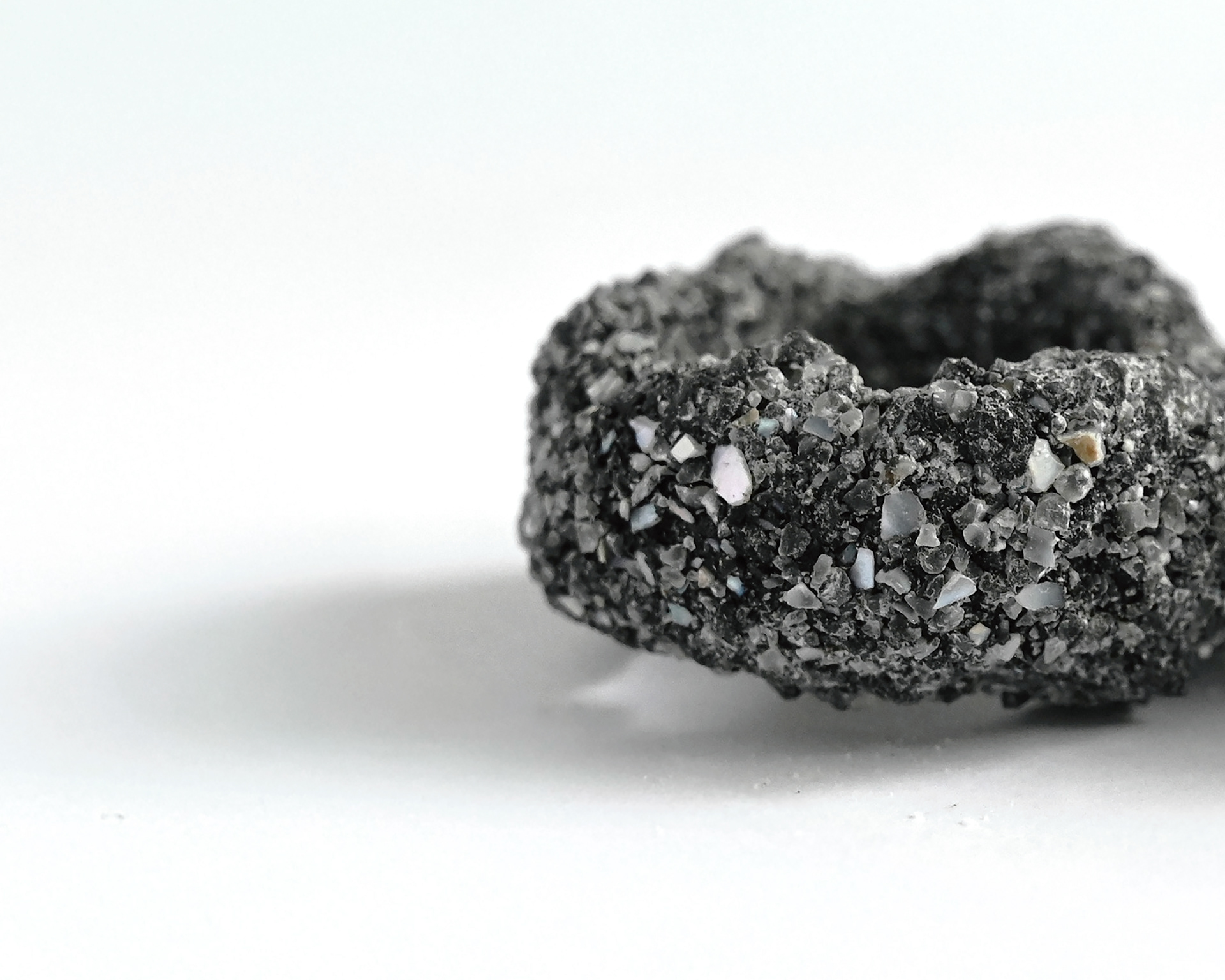
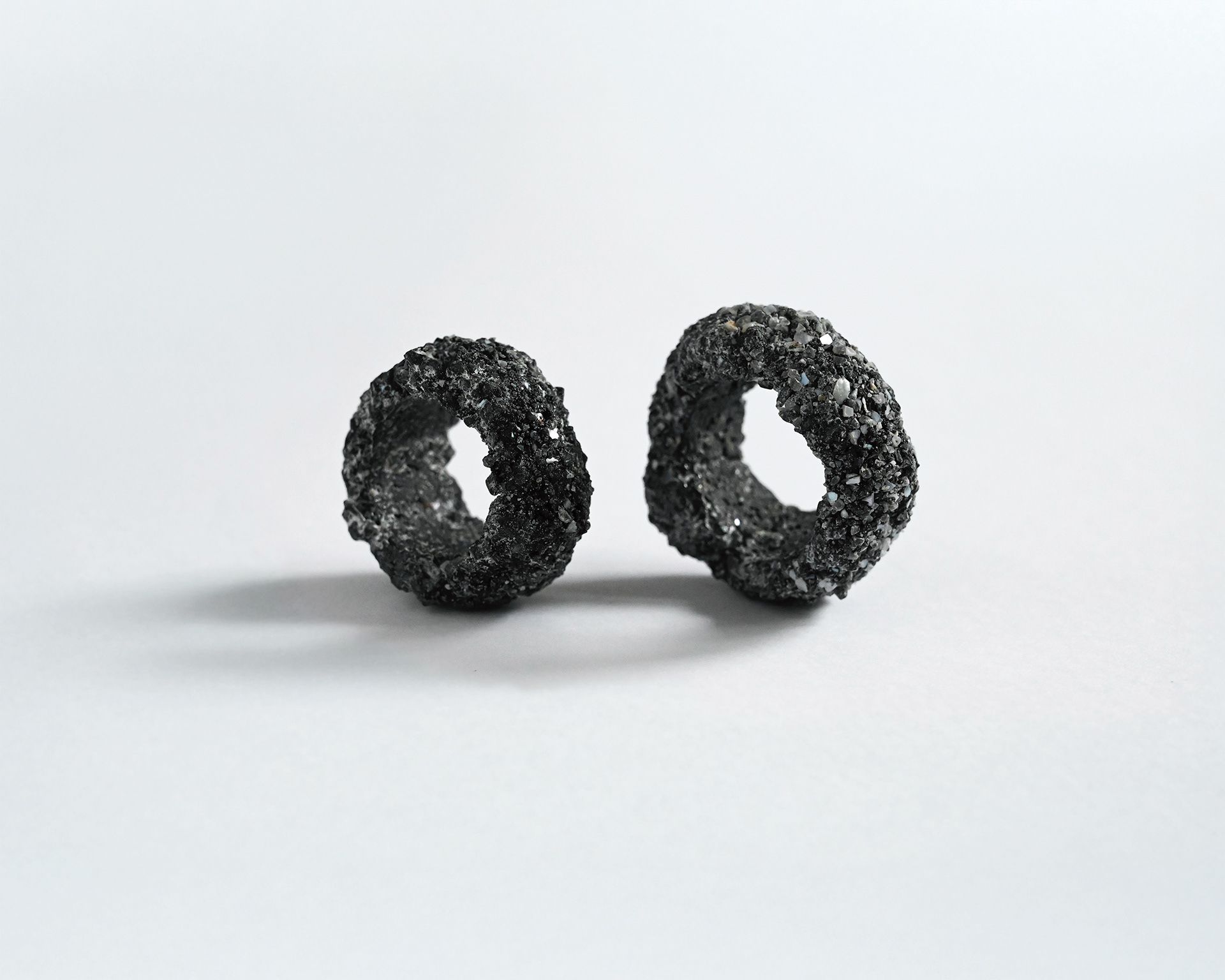
By pulverizing and blending them into a single material, I aim to dissolve the notions of cultural hierarchy and origin, transforming these symbols of national identity into a new, collective matter—a shared cultural substance. This act is not one of destruction, but of regeneration and coexistence.
The blended material is formed into a pair of rings. The hand, which wears them, is both a symbol of labor and a vessel of memory—an archive of humanity’s continuous intervention in nature. The gesture of a handshake, meanwhile, represents trust, friendship, and connection. Through these paired rings, I wish to present a positive vision of coexistence between nature and the artificial, Japan and China—where differences do not divide, but sustain one another.
この作品は、中国人の友人から養殖の淡水真珠を受け取ったことを出発点としています。手にしたその素材が、日本と中国における文化・技術の往来と、今日の友好のあり方を考察する契機となりました。
「養殖」という行為は、人間が自然に介入し、価値を生成するプロセスです。真珠の養殖では、貝の身体に異物を挿入し、その拒絶反応が層を重ねて光沢を帯びることで「宝石」となります。私自身の背景とも重なる米の栽培においても、人間は水や土を制御し、異質な要素を導入することで「糧」を得てきました。いずれも自然と人工の境界を横断しながら、人間社会における文化的価値を生み出してきたのです。
ジュエリーもまた、人間の労働と技術によって自然物に価値を付与し、制度的な意味を帯びる営みです。その意味で、ジュエリーはすでに養殖的プロセスそのものだといえます。
本作では、その象徴として「米」「養殖真珠」、そして「漆」を素材に選びました。米は古代に中国大陸から日本へと伝来し、養殖真珠の技術は近代に日本から中国へと渡ったとされます。漆もまた、古くから中国と日本の芸術文化を支えてきた重要な素材であり、その起源や技術の優劣をめぐって論争が繰り返されてきました。漆の木は自然の樹液を生み出す存在でありながら、人間の手によって植林され、採取や管理が行われています。人間が使用する目的のために育てられ、守られるという点で、漆もまた真珠や米と同様に「養殖的」な素材であるといえます。これら三つの素材は、いずれも自然と人間の協働によって育まれた「文化的生命体」として位置づけられます。
私は、これらの素材を粉砕し、一つに混ぜ合わせることで、国や文化の優劣、あるいは起源をめぐる論争を解体し、新たな共通素材=共有可能な文化的マテリアルを生み出すことを試みています。それは破壊による終焉ではなく、再構成による共生の試みです。
この新しい素材は、「指輪」という形式に造形されます。手は労働を象徴する身体部位であり、人間が自然に介入し、価値を創出してきた歴史の記憶を宿しています。そして握手は、相互理解や友好の証としての象徴でもあります。これらのことから本作ではペアリングを制作し、自然と人工、日本と中国といった関係を、対立ではなく相互的で肯定的な関係として捉え直したいという願いを込めています。